
On-Ground vs Off-Plan Etihad Town Plots: Buyer Guide
Direct answer: On-ground and off-plan describe different property states, but the labels are often used loosely in advertisements. An on-ground Etihad Town plot should be identifiable on the current site plan, while an off-plan product may still depend on allocation, ballot or future development. Neither label by itself proves ownership, clear dues or possession.
Reviewed 19 August 2026. Prices, inventory and development status can change. Verify the exact plot and current official documents before payment.
Prepared and reviewed by Ahsan Anwar, Authorized Sales Partner at Ahmad & Sons, with 8+ years in real estate.
Quick comparison
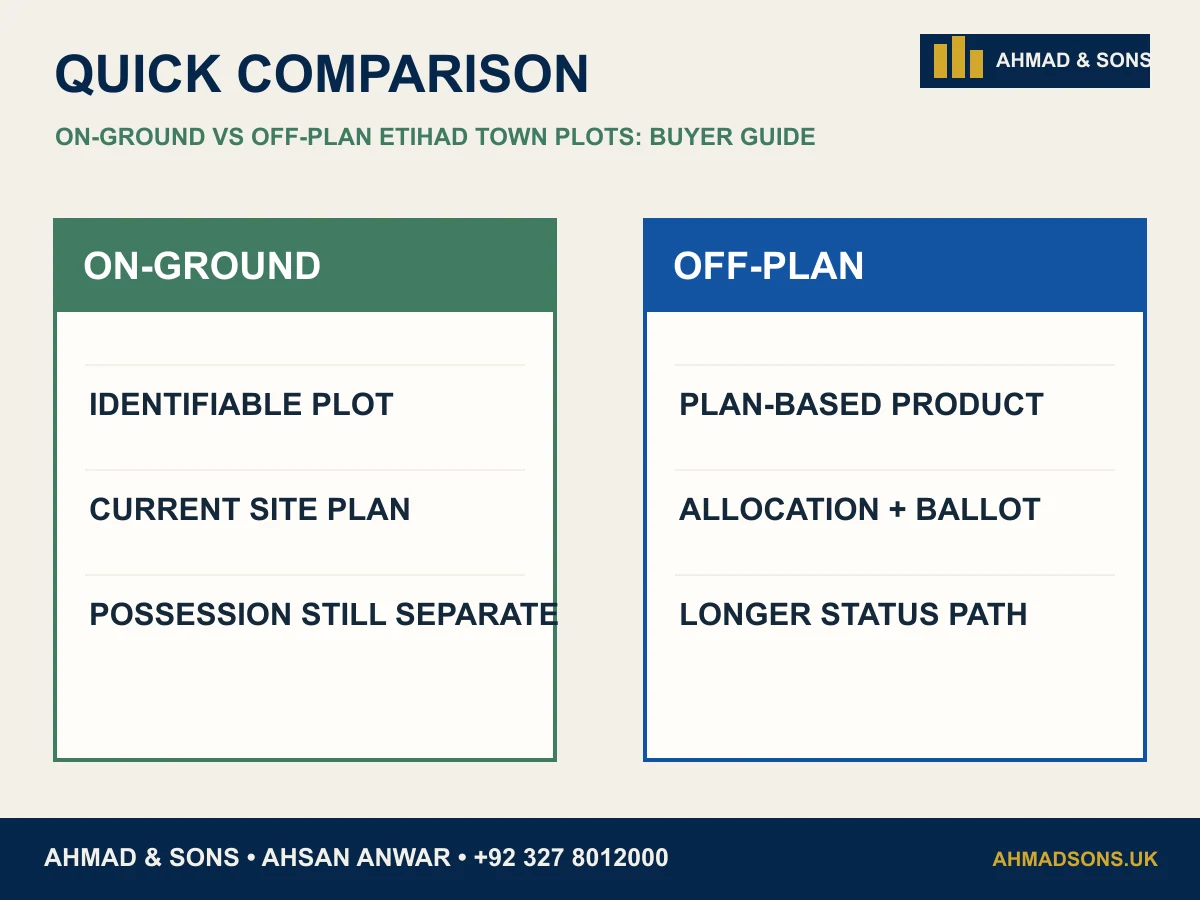
| Question | On-ground | Off-plan |
|---|---|---|
| Can the plot be identified? | Should match current plan | May depend on allocation/ballot |
| Possession automatic? | No—verify separately | Usually a later stage |
| Price pattern | Often higher | Often lower entry |
| Main document risk | Wrong plot/status claim | Unclear allocation/timeline |
| Core evidence | Plan, marker, ownership, ledger | File, allocation, plan, schedule |
What on-ground should mean in practice
The plot number, block, phase and size should match a current site plan, and the location should be capable of physical identification. Ask to see the site and compare it with the document record. A dealer pointing to open land is not enough.
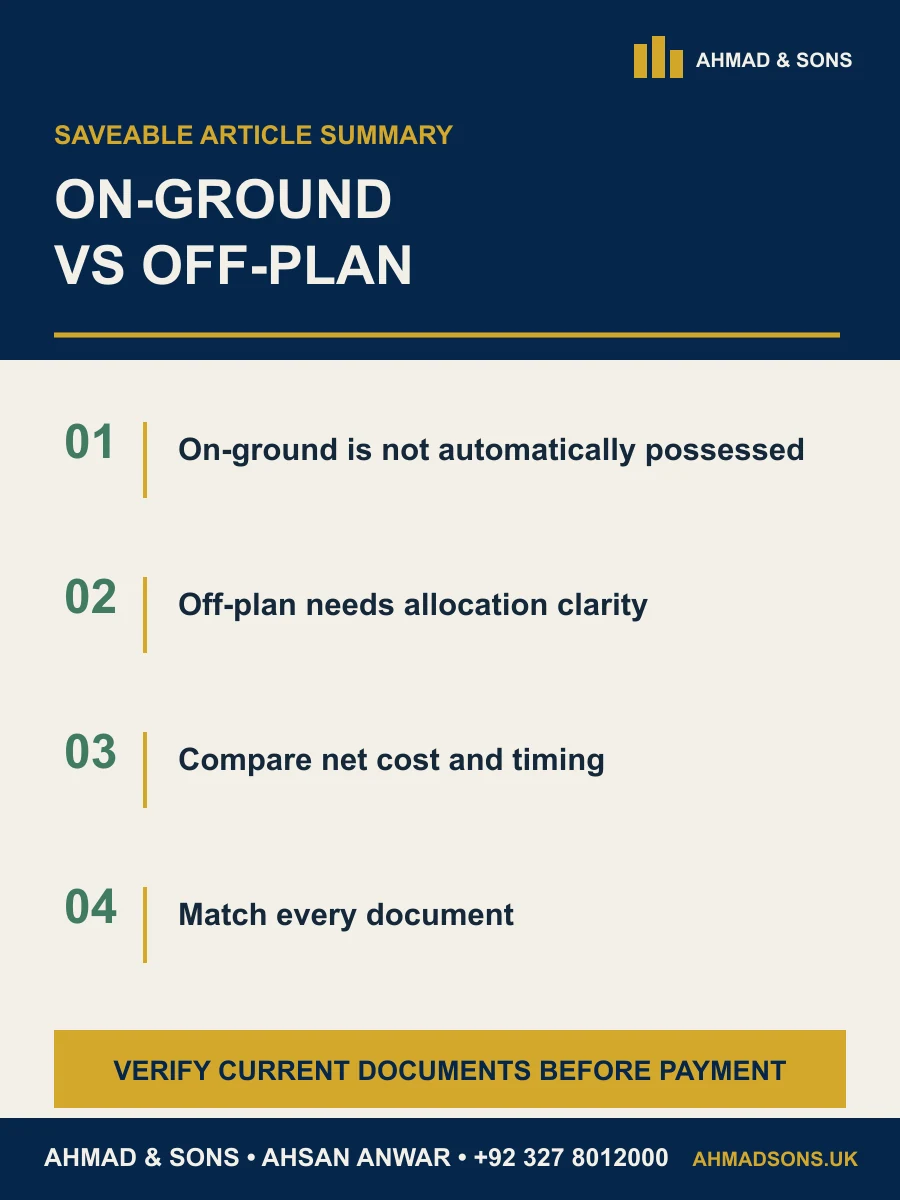
Possession is a separate check. A plot may be identifiable yet still carry unpaid charges, incomplete services or no plot-specific possession letter.
What off-plan buyers need to understand
An off-plan purchase may begin with a file or booking tied to a product category rather than a final plot location. Clarify allocation, ballot conditions, payment milestones, development charges, cancellation rules and the event that creates possession eligibility.
The lower initial amount must be compared with the longer schedule and greater status uncertainty. Do not describe future development, delivery or appreciation as guaranteed.
A five-document decision test
For on-ground, compare ownership or allotment record, current site plan, payment ledger, NDC where applicable and possession evidence. For off-plan, compare booking or allocation record, customer identity, payment schedule, official receipts and written ballot or possession terms.
If the advertisement and documents use different words—such as plot versus file, allocated versus unallocated, or possession versus possession expected—stop and resolve the difference before paying.
Before you pay: practical checklist
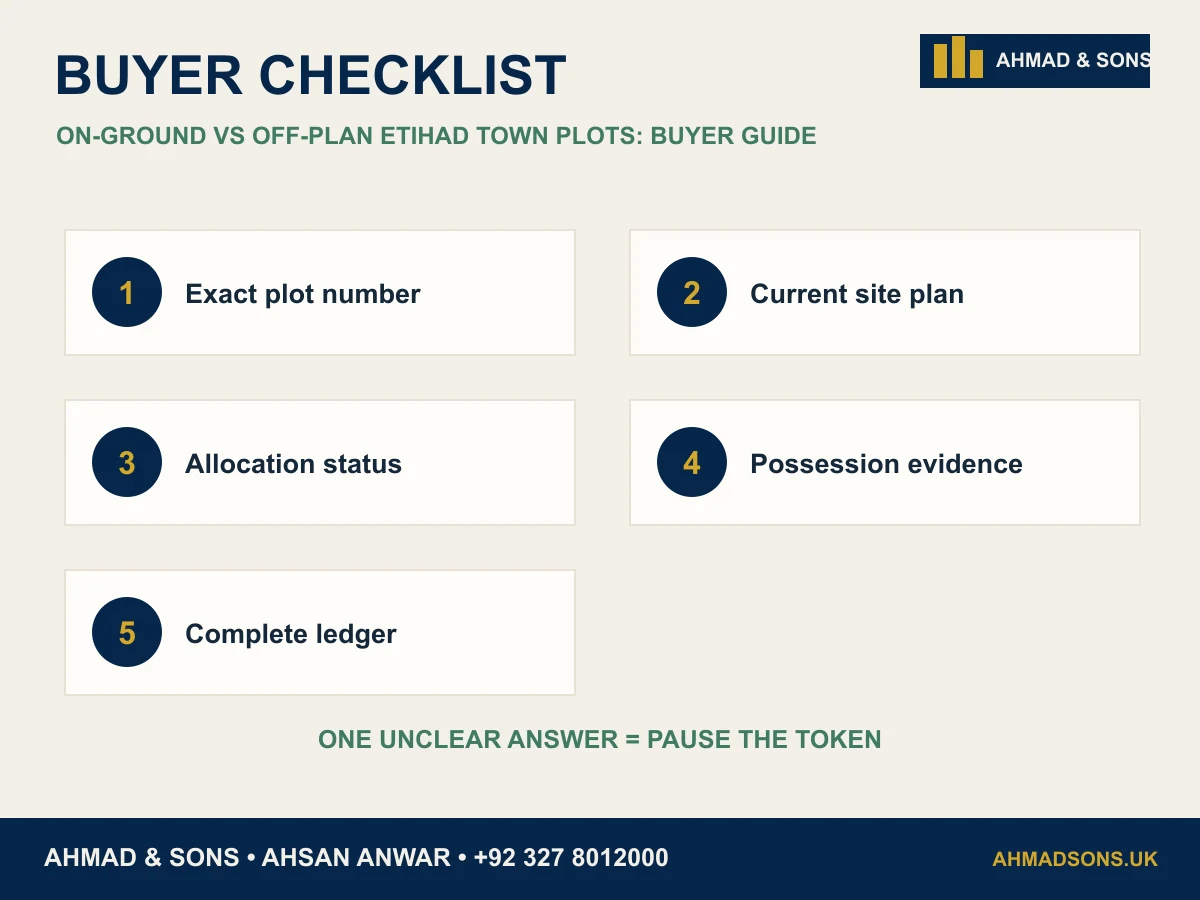
- Exact plot number
- Current site plan
- Allocation status
- Possession evidence
- Complete ledger
How to assess a live offer
Start with the exact product being offered, not the headline price. Write down the phase, block, plot number, size, category and quoted amount, then match each detail with the current site plan and the seller’s documents. Ask for a dated cost sheet showing the booking amount, every instalment, ballot or confirmation payment, possession payment, development charges and any location premium. This makes different offers comparable on a complete-payable basis.
Keep a simple evidence pack containing the advertisement, ownership or allocation document, seller identity, payment ledger, current NDC where applicable, official receipts and the written transfer procedure. Treat developer-published information as the source for scheme-wide prices and schedules, but verify plot-specific availability and status separately. If one material detail conflicts, pause the token payment until the discrepancy is resolved in writing.
Need the latest Etihad Town availability or want to arrange a site visit? Talk to Ahsan Anwar at +92 327 8012000.
Related Ahmad & Sons guides
Frequently asked questions
Is on-ground always safer?
It can provide more location evidence, but ownership, dues and possession still require verification.
Why can off-plan be cheaper?
It may involve an earlier development or allocation stage and a longer payment path.
Can a file be sold as a plot?
The advertisement must accurately describe the document and allocation status. Do not accept the terms as interchangeable.
Sources and verification note
- Official Phase 2 product tables — accessed 19 August 2026.
- Official forms — accessed 19 August 2026.
This guide explains published information and a buyer-verification process. It does not promise availability, approval, possession, appreciation, rental income or a fixed journey time.